What happens when adaptation stops feeling like compromise and starts feeling like selfhood?
Listen to the episode on Spotify!
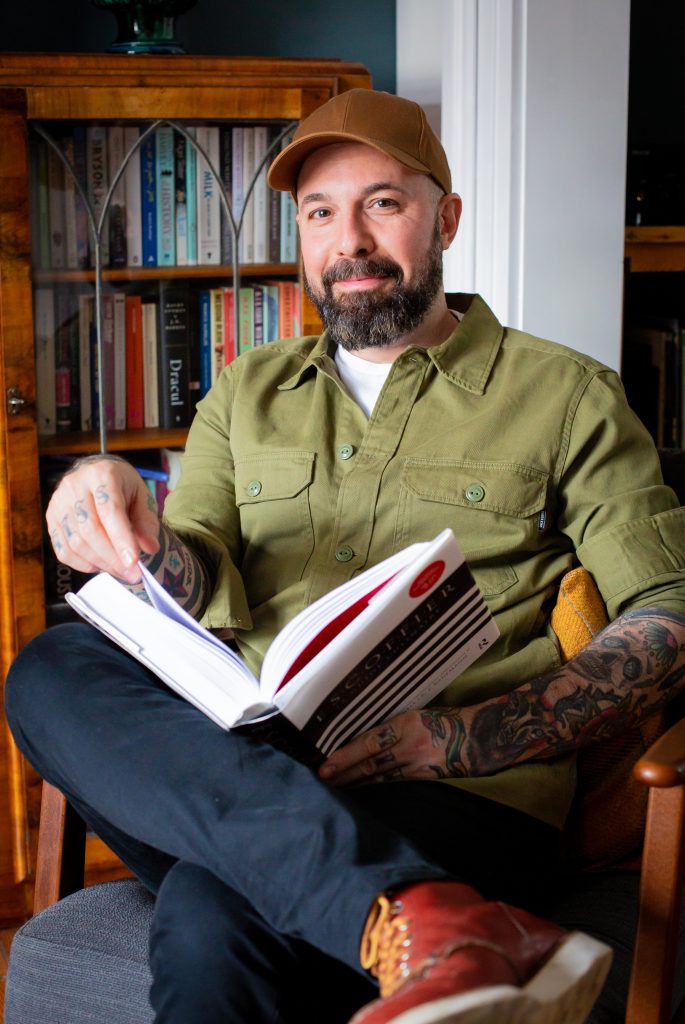
In this latest episode of A Curious Appetite, I spoke with chef and writer Emiliano Amore about migration, identity, craving, and the kitchens we build between cultures. Emiliano, who was born in Rome and is now based in Brighton, writes Britalian on Substack, where he explores the meeting point between British and Italian food.
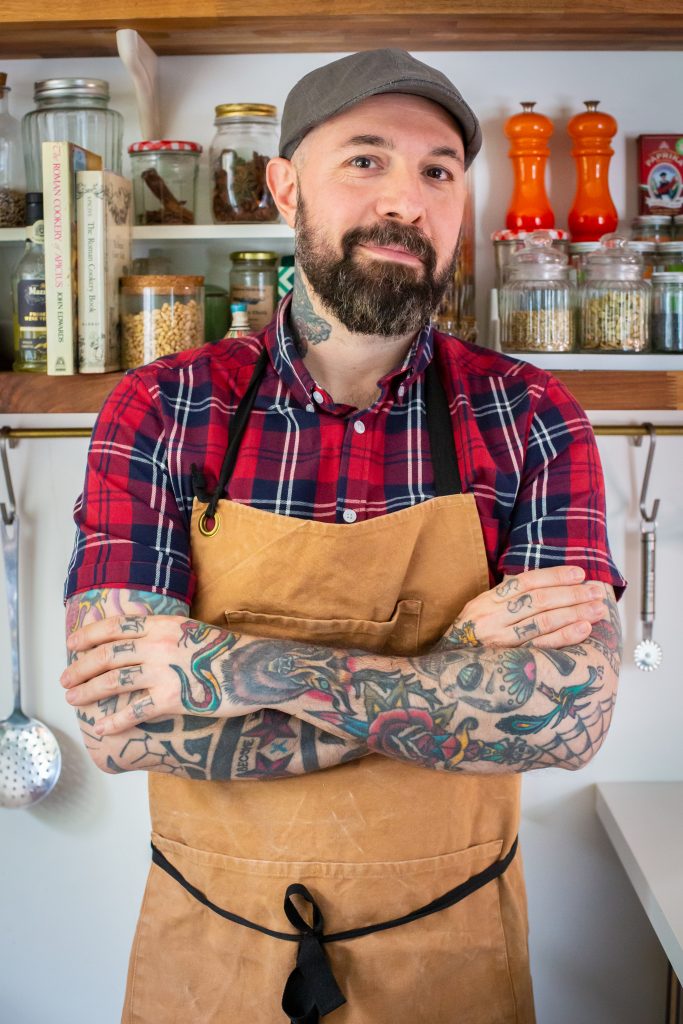
What emerged in our conversation was not simply a discussion of ingredients or recipes, but a meditation on belonging, reinvention, and the emotional life of food.
Our conversation began with the word “Britalian”, a term that at first sounds playful but quickly opens onto much deeper questions. For Emiliano, this is not simply about mixing two cuisines or placing one national tradition beside another. It is about the lived reality of becoming. It is about finding yourself in between cultures, between ingredients, between cravings, and between ideas of home. As he puts it, adaptation eventually stopped feeling like substitution and became his actual self.
That thought stayed with me. It speaks to something I find endlessly compelling: the way food can register shifts in identity before language catches up. Sometimes the palate changes before the story does. Sometimes what we crave reveals where we are, who we are becoming, and what we are learning to love.
We talked about the stereotypes that flatten both British and Italian food. Fish and chips on one side, pizza and pasta on the other. Emiliano is brilliantly alert to the danger of these caricatures, and to the way they are used to simplify cuisines that are, in reality, layered, regional, hybrid, historical, and shaped by movement. He spoke of loving an England of puddings, offal, pickles, black pudding, liver and bacon, shortbread, and experimentation at home. He also spoke of an Italy far removed from cliché: a world of coratella, coda alla vaccinara, Anna Magnani, Pasolini, and Rome as a crossroads of influences rather than a sealed culinary myth.
One of the most intruiguing ideas to emerge from the conversation was Emiliano’s phrase “the liminal larder”. He uses it to describe the space between cultures where ingredients and habits meet without cancelling one another out. Branston pickle meets pecorino. Cheddar finds its way into lasagna. Oats replace breadcrumbs. Pickles stand in conversation with capers. This is not compromise, he argues. It is a frontier. For some, perhaps, a wild one. For others, home.
That sense of home was central to the episode. At one point Emiliano said, “My home is where my table is,” and it seemed to me one of the clearest and most generous expressions of migrant belonging I have heard in a long time. Food here is not merely sustenance or nostalgia. It is a practical and emotional structure for living. It is where memory, appetite, and reinvention meet.
We also talked about ingredients and emotional weight. Emiliano reflected on the parcels that arrive from home when you first move abroad, on a mother’s jam or a grandmother’s preserved aubergines in oil, and on the way those objects carry care across distance. But he also made a distinction I found moving and useful: ingredients may carry nostalgia, but recipes carry emotional architecture. Ingredients are tools. Recipes are the opera. That is where the feeling lives.
Elsewhere in the conversation we wandered into questions of culinary history, eighteenth-century cookery writing, Hannah Glasse, the Grand Tour, the old “macaronis”, and the longer history of exchange between Britain and Italy. We spoke about fish and chips and baccalà fritto, trifle and tiramisù, and whether dishes can be understood as distant relatives that speak the same emotional language through different ingredients. We ended, fittingly, with childhood memory, comfort food, and the foods Emiliano returns to in thought and appetite: his grandmother’s ricotta and spinach ravioli, remembered as enormous through the eyes of a child, biscuits, haggis, and the quiet, private rituals of eating that comfort us most.
It was a rich and generous conversation, full of intelligence, humour, and feeling. Above all, it reminded me that food is never static. It moves with us. It absorbs history, geography, class, language, desire, and compromise. It reveals the limits of categories and the possibilities of becoming.
Listen to Emiliano Amore: On Love for the Liminal Larder on A Curious Appetite now.
P.S. I have something else to add. As Emiliano spoke about his grandmother’s ravioli, it stirred something in me. The memory did not remain contained within the conversation. Instead, an image came to mind: a little boy, eyes widening at the sight of the biggest piece of pasta he had ever laid eyes on, fork at the ready. It opened onto something of my own: the ways in which food holds, distorts, and returns memory to us. So, I wrote something inspired by his story…
Pasta, Amore e Fantasia!
Emiliano and the Giant Raviolo
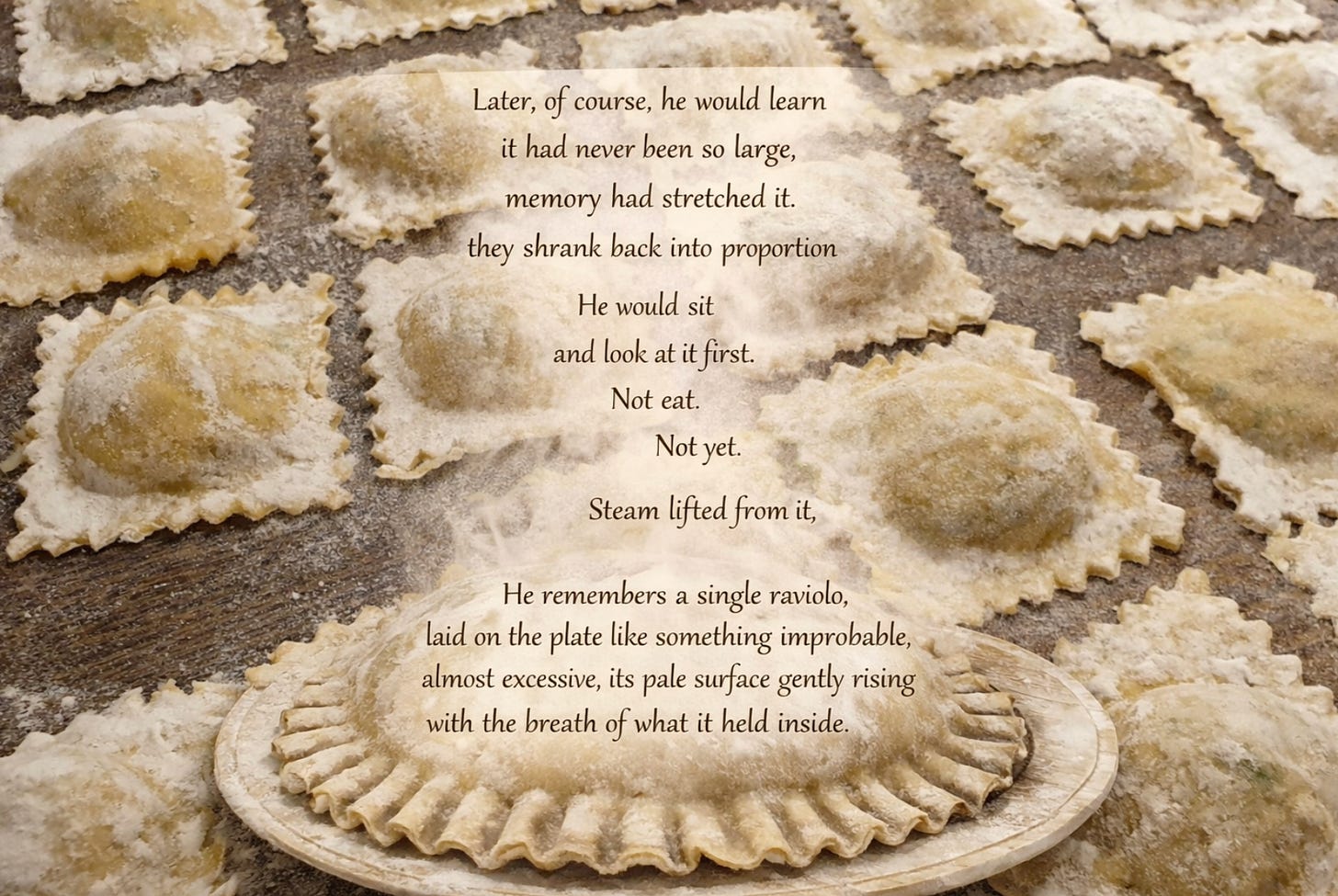
He remembers a single raviolo laid on the plate like something improbable, almost excessive, its pale surface gently rising with the breath of what it held inside. It seemed too large to belong to the world of ordinary things, too generous, too complete.
To a child, it was not one piece among many, but an event.
He would sit and look at it first. Not eat. Not yet.
The edges were sealed with care, pressed into soft ridges that felt like a kind of language he could not yet read. Steam lifted from it, carrying something warm, green, and faintly sweet. Ricotta and spinach, though he would not have named them then. Only recognised them as something that belonged to her hands.
It took time. Five, six bites, perhaps more. Each mouthful deliberate, as if the raviolo could not be hurried, as if it required a kind of attention that bordered on reverence.
The plate seemed to hold nothing else. The world, for a moment, arranged itself around this single, oversized thing.
Later, of course, he would learn that it had never been so large. That memory had stretched it, as it stretches all things that matter.
He would try, at some point, to make them again, to return them to that impossible scale. But they resisted him. They shrank back into proportion, into adulthood, into reason.
And yet, somewhere, it remains: that enormous raviolo, held in the gaze of a small boy, still waiting to be finished.