For this episode of A Curious Appetite, I had the pleasure of speaking with Mallika Basu, food writer, broadcaster, and author of In Good Taste: What Shapes What We Eat and Drink and Why It Matters. It was one of those conversations that opens out very quickly from the plate into much wider questions of history, migration, emotion, and power.
We began with a simple but deceptively difficult question: when does food stop being personal and become political?
For Mallika, that moment came when she moved to the UK and began to see more clearly what “curry” meant in British cultural life. What might first appear to be a simple matter of taste or cuisine is in fact bound up with migration, assimilation, empire, and the long afterlives of colonial power. As she put it, curry in Britain is “a very British phenomenon,” and the problem begins when that category is used to stand in for the enormous variety of Indian and South Asian food traditions.
That flattening matters.
One of the most powerful things Mallika said was that “recipes don’t have IP, but they have meaning.” It is such a precise way of describing the emotional and cultural stakes of food. Recipes may not belong to us in a legal sense, but they do carry memory, origin, and story. They come from somewhere. They are rooted in people, regions, histories, and acts of survival.
This is why debates around food can feel so charged. From the outside, reactions to misuse or misrepresentation can sometimes seem disproportionate. But as Mallika explained, food is never just food. It is “meaning, memory, culture, identity,” and for diasporic communities in particular it can become a bridge to home, to ancestors, and to a place from which one may be geographically distant.
That stayed with me, perhaps because it resonates so strongly with my own work on cultural memory. We often describe food as comforting, nostalgic, domestic. But food is also an archive. It carries traces of who had power, who moved, who adapted, who survived, and who was forced to remake home elsewhere.
What does “authentic” even mean?
We spoke about authenticity, that endlessly invoked and endlessly unstable word.
Mallika’s response was both refreshing and clarifying. She pointed out that when people describe food as “authentic,” they often imagine that they are appealing to tradition. But tradition itself is not fixed. How far back do we go? To our grandmother’s kitchen? Her grandmother’s? A precolonial past? A pre-migration one? At what point does adaptation become inauthentic, and who gets to decide?
For Mallika, authenticity in food is not about frozen purity. It is about what is true to lived experience. “The true meaning of authentic in the food world,” she said, “is actually what is true to you.” That might mean cooking with what is available locally, adjusting to a different country, a different schedule, a different life. For her, authentic Indian cooking in the UK means being part of the global Indian diaspora and making food that fits her reality.
That definition feels far more honest than the tired policing of “real” and “fake” food. It also makes space for migration, creativity, and survival.
At the same time, Mallika was careful not to collapse everything into relativism. There is still a difference between transformation grounded in knowledge and experience, and a careless appropriation that strips food of its context. “Recipes don’t have IP,” as she said, “but they have meaning.” That line bears repeating.
Curry houses, migration, and the limits of multicultural celebration
One of the most fascinating parts of the conversation centred on the British curry house, which is so often held up as a symbol of multicultural Britain. Mallika complicates that story in important ways.
Yes, curry houses became beloved institutions. Yes, they are part of the cultural fabric of Britain. But they also emerged from very specific conditions of migration, exclusion, and necessity. Many restaurant owners moved into this work because other routes into the economy were closed to them. Curry houses were not simply cheerful sites of multicultural exchange. They were also responses to isolation, labour, and structural constraint.
Mallika made the point beautifully that what stalls progress is not really authenticity or inauthenticity as such, but a refusal to let go of an old worldview. We keep using the term curry to describe an incredibly diverse and regionally varied set of cuisines, and in doing so we reproduce a simplified, hegemonic understanding of South Asian food. “We’re just not listening to people,” she said.
That, to me, is at the heart of the matter.
Food systems, anxiety, and the choices we can actually make
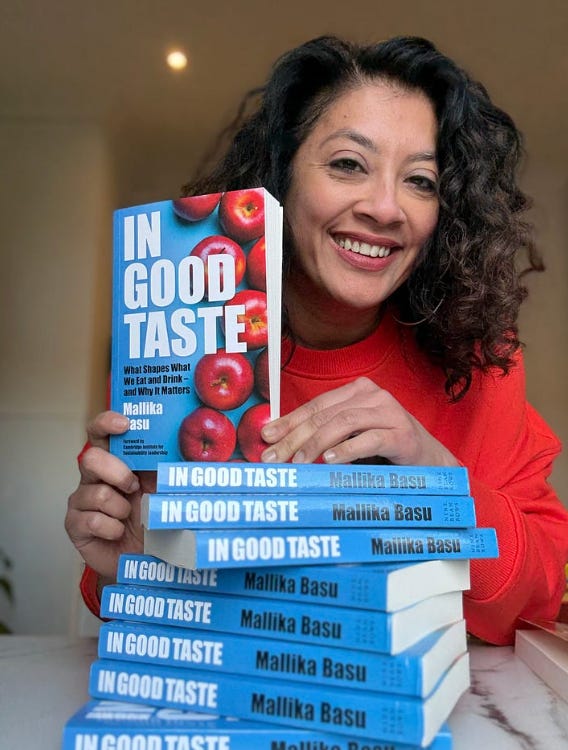
We also talked about her new book, In Good Taste, and the larger questions it asks about what shapes our ideas of what is “good” or “bad” food. The book moves beyond cooking and eating into culture, social justice, environmental justice, and the structures that shape what ends up on our plates.
Mallika described writing it as “unpeeling the most complicated onion” she had ever encountered, which felt wonderfully apt. Food systems are layered, emotional, and difficult to parse. They produce anxiety partly because they place moral pressure on consumers who often have limited power, limited time, and limited resources.
This was one of the things I most appreciated in our conversation. Mallika is deeply serious about justice, but she is not moralising. She recognises the reality of constraint. “We are time poor, we are cash poor,” she said, and that simple line captures so much of contemporary food anxiety. We may want to buy the carefully sourced, artisanal, ethically perfect thing, but many of us simply cannot.
And yet, she also insists that we do have agency. “Every choice we make,” she said, “every time we put our hands in our wallets… we are voting for something.” Not because consumers alone can transform the food system, but because culture matters, and our tastes shape the world around us more than we sometimes admit.
That is the strength of In Good Taste. It refuses despair without slipping into fantasy. It asks us to think more carefully, but not to collapse under the weight of perfectionism.
Mangoes, memory, and the comfort of rice on the sofa
As always on A Curious Appetite, I wanted to end by asking about food memory.
Mallika’s answer was immediately vivid. Not a formal dish at first, but a fruit: the mango. Her description was glorious and tactile. As a child, she remembered being “stripped naked, parked in the bathtub,” and handed a mango to eat, letting it drip everywhere, sticky and golden and abundant. It was one of those sensory memories that instantly creates its own world.

That image brought back one of my own. When I lived in South America, my brother and I used to throw pieces of ice at the mango tree opposite our building so the fruit would fall and we could run out to collect it. I love moments like that in conversation, when one food memory unlocks another.
Later she described the vibrant range of food in her family home in Kolkata: roast lamb one Sunday, biryani another, pasta or soup after school, cookbooks on the shelf, a father who cooked, a mother who loved food but resisted the oppressive routine of feeding the family every day. It was such a rich reminder that domestic food cultures are rarely singular or static.
And when I asked what she loves eating on the sofa while watching television, her answer was wonderfully honest: biryani, or a big bowl of fried rice in her lap under a throw. “It’s so comforting,” she said. Quite right too.
Honour your struggle
There was a moment towards the end of our conversation when we briefly touched on parenting and the quiet labour of holding things together in family structures that do not always fit conventional narratives.
Mallika said something that stayed with me. Recalling advice from Iqbal Wahhab, she said: “Honour your struggle.”
I loved that. There is something generous and grounding in it. Not wallowing, not self-dramatising, but simply acknowledging the work of living, raising children, building a career, and continuing anyway. It is advice that belongs not only to family life, but to food writing, cultural work, and perhaps to all forms of creative labour.
Our conversation reminded me once again why food matters so much. Because it is never only about eating. It is about what we inherit, what we adapt, what we defend, and what we hope to pass on. It is about memory, but also about power. It is about comfort, but also about conflict. It is about what feels true, and who is allowed to define that truth.
If you’d like to hear the full episode, you can listen on A Curious Appetite. And if these themes speak to you, do seek out Mallika Basu’sIn Good Taste, which is thoughtful, accessible, and full of insight.
For more essays and curious extras, you can subscribe to my Substack here.